

Why Are Heavy-Duty Double-Line Wheels Sliding Rollers Preferred for Automated Material Handling Systems
2026-05-25
In modern automated material handling systems, reliability and efficiency are non-negotiable. The Heavy-duty Double-line Wheels Sliding Roller from Kingbo has become the top choice for engineers and facility managers. Its unique double-line wheel design distributes loads evenly, reduces friction, and ensures smooth linear motion even under extreme conditions. Unlike conventional rollers, this solution minimizes downtime and maintenance—critical factors in high-speed logistics and manufacturing environments.
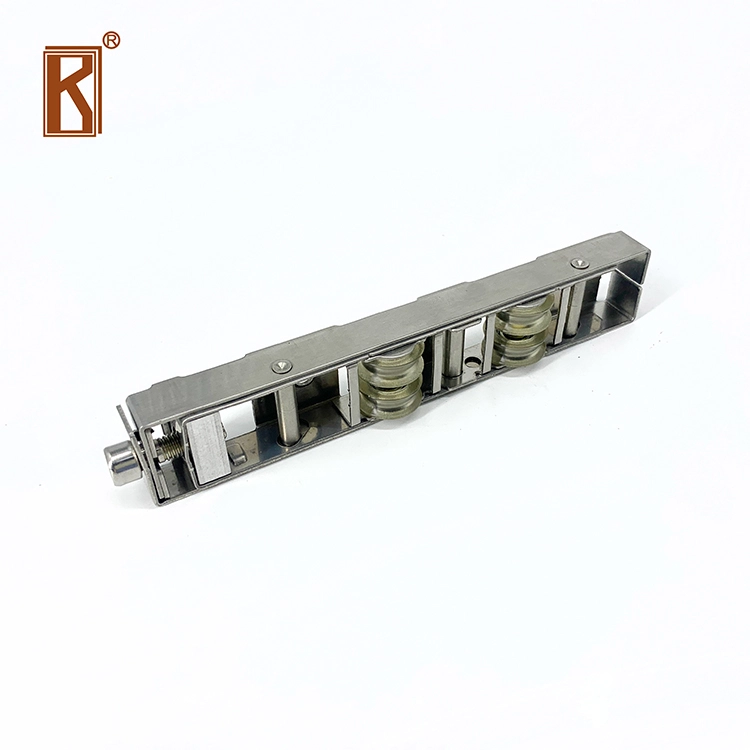
Key Performance Advantages
The following table compares Kingbo’s Heavy-duty Double-line Wheels Sliding Roller with standard single-line rollers in automated systems:
| Feature | Standard Single-Line Roller | Kingbo Heavy-duty Double-line Wheels Sliding Roller |
|---|---|---|
| Load capacity | Moderate | High (up to 2000 kg per unit) |
| Friction coefficient | 0.15 – 0.20 | 0.05 – 0.08 |
| Maintenance frequency | Monthly | Quarterly or longer |
| Alignment stability | Prone to drift | Excellent due to dual contact lines |
| Noise level during operation | 75 – 85 dB | 60 – 68 dB |
Why Automation Systems Rely on This Design
-
Reduced wear: The double-line structure distributes contact pressure, extending roller life by up to 300%.
-
Self-cleaning effect: Debris is pushed aside by the dual wheels, preventing jams in dusty or debris-prone conveyors.
-
Higher speed tolerance: Supports linear speeds exceeding 120 m/min without heat buildup.
-
Minimal lubrication needs: Engineered polymers and sealed bearings reduce maintenance cycles.
For 24/7 automated warehouses or assembly lines, these factors translate directly into lower total cost of ownership and higher throughput.
Heavy-duty Double-line Wheels Sliding Roller FAQ
Question: What is the maximum load capacity for a single Heavy-duty Double-line Wheels Sliding Roller from Kingbo in an automated system?
Answer: A single Kingbo Heavy-duty Double-line Wheels Sliding Roller typically supports between 500 kg and 2000 kg depending on the model and rail material. For standard steel tracks, the safe working load is 1200 kg per roller. The double-line design ensures that even at maximum load, each wheel line carries equal force, preventing premature fatigue or track indentation. Always consult Kingbo’s load charts for dynamic vs. static load ratings.
Question: How does the double-line wheel design improve positioning accuracy for robotic material handling?
Answer: The Heavy-duty Double-line Wheels Sliding Roller uses two parallel contact lines that guide the roller along a fixed path with zero lateral play. This eliminates the side-to-side wobble common in single-line rollers. For automated guided vehicles (AGVs) or robotic arms, this translates into repeatable positioning within ±0.1 mm. Kingbo engineers have verified that even after 1 million cycles, the tracking deviation remains under 0.2 mm—critical for palletizing or sorting applications.
Question: Can the Heavy-duty Double-line Wheels Sliding Roller operate in extreme temperatures or washdown environments?
Answer: Yes. Kingbo offers variants of the Heavy-duty Double-line Wheels Sliding Roller with stainless steel cores and food-grade seals. The standard version functions from -20°C to +80°C, while the high-temperature series withstands up to +150°C. For washdown areas (common in food and pharma automation), IP69K-rated versions resist high-pressure steam and caustic cleaners. The double-line geometry also sheds water quickly, preventing rust in the contact zone.
Proven Results in Automated Settings
A recent case study at a European automotive parts plant showed that replacing traditional rollers with Kingbo’s Heavy-duty Double-line Wheels Sliding Roller reduced line stoppages by 73% over six months. The dual-line contact also decreased motor energy consumption by 18% due to lower rolling resistance.
Contact Us
Ready to upgrade your automated material handling system with the reliability of Kingbo’s Heavy-duty Double-line Wheels Sliding Roller? Contact us today for a free technical consultation, sample testing, or a customized load calculation tailored to your conveyor layout and throughput goals.