

How Does an Air Curtain Generate a High-Speed Airflow Barrier?
2026-09-10
1. What Is the Physical Principle Behind an Airflow Barrier?
An Air Curtain works by creating a continuous stream of high-velocity air across the full width and height of a doorway. This air stream acts as a virtual door that separates the indoor and outdoor environments. The barrier is effective because the momentum of the air stream resists the pressure difference between the two spaces. The pressure difference can be caused by wind, stack effect (the tendency of warm air to rise), or mechanical ventilation. The key parameter is the air velocity at the discharge nozzle. If the velocity is too low, the air stream will be deflected by the pressure difference and the barrier will fail. If the velocity is too high, the air stream will generate turbulence and noise, and it may actually increase the infiltration of outdoor air by entrainment.
The momentum equation: The barrier strength is proportional to the mass flow rate multiplied by the velocity. For a given door width, the mass flow rate is determined by the nozzle discharge area and the air density. The velocity is determined by the fan speed and the nozzle design. The optimal velocity is typically 10 to 15 m/s for a door height of 2 meters, and 15 to 20 m/s for a door height of 3 meters.
In our factory, we design Air Curtain units with a precise nozzle geometry that produces a uniform velocity profile across the full discharge width. A non-uniform profile creates weak spots where the barrier can be breached. We use computational fluid dynamics to optimize the nozzle shape and the fan impeller design.
2. What Are the Key Components That Determine Air Curtain Performance?
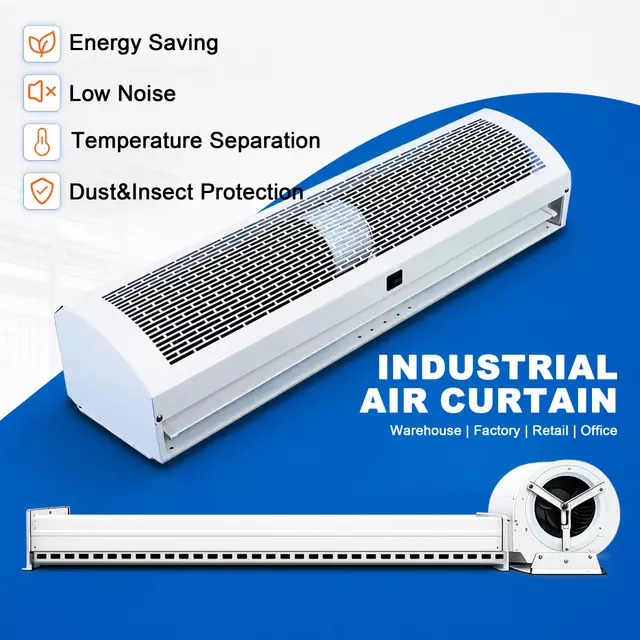
An Air Curtain consists of four main components: the fan, the nozzle, the housing, and the control system. The fan generates the airflow. We use centrifugal fans with forward-curved impellers for low-noise applications and backward-curved impellers for high-pressure applications. The nozzle directs the airflow into a concentrated stream. The housing contains the fan and the nozzle, and it determines the mounting configuration. The control system manages the fan speed, the heat output (for heated models), and the door activation. The table below shows the typical specifications for our standard Air Curtain models.
| Model | Door width (mm) | Max door height (mm) | Air velocity (m/s) | Air volume (m³/h) | Power (W) | Noise level (dB) |
| EB-1000 | 900 – 1000 | 2000 | 12 – 14 | 1100 | 120 | 52 |
| EB-1500 | 1400 – 1500 | 2500 | 13 – 15 | 1800 | 180 | 55 |
| EB-2000 | 1900 – 2000 | 3000 | 15 – 18 | 2600 | 250 | 58 |
| EB-2500 | 2400 – 2500 | 3500 | 17 – 20 | 3400 | 320 | 61 |
The air velocity at the nozzle is the most important specification. A velocity below 10 m/s will not create an effective barrier for a door height of 2 meters. A velocity above 20 m/s will create excessive noise and turbulence. Our factory tests every Air Curtain model at the specified door height to verify the barrier effectiveness.
3. How Does Installation Geometry Affect Barrier Effectiveness?
The installation geometry is as important as the Air Curtain itself. The unit must be mounted horizontally above the door, with the discharge nozzle facing downward. The distance between the nozzle and the door header should be minimized to prevent air from escaping around the sides. The nozzle angle should be slightly toward the outside (5 to 10 degrees) to counteract wind pressure. If the unit is mounted too high above the door, the air stream will lose velocity before it reaches the floor, and the barrier will be incomplete. The table below shows the recommended installation parameters for different door heights.
| Door height (mm) | Recommended mounting height above door (mm) | Recommended nozzle angle (°) | Minimum air velocity at floor (m/s) | Required air volume (m³/h per meter width) |
| 2000 | 0 – 100 | 5 – 10 | 2.0 | 1100 |
| 2500 | 0 – 100 | 5 – 10 | 2.5 | 1400 |
| 3000 | 0 – 150 | 10 – 15 | 3.0 | 1700 |
| 3500 | 0 – 150 | 10 – 15 | 3.5 | 2000 |
The minimum air velocity at the floor is the velocity required to maintain a continuous barrier at the bottom of the door. If the velocity drops below this value, the barrier will be breached by foot traffic or wind. In our factory, we recommend that the Air Curtain be mounted as close to the door header as possible. We also provide adjustable mounting brackets that allow the nozzle angle to be fine-tuned on site.
4. What Are the Common Mistakes That Reduce Air Curtain Effectiveness?
There are four common mistakes that reduce the effectiveness of an Air Curtain. The first is undersizing the unit for the door width. An Air Curtain that is too narrow will leave gaps at the sides of the door. The second is mounting the unit too high above the door. The air stream will lose momentum before it reaches the floor. The third is failing to seal the sides of the doorway. If there are gaps between the Air Curtain and the door frame, air will escape around the ends of the unit. The fourth is operating the unit at too low a speed. Some facility managers reduce the fan speed to save energy or reduce noise, but this compromises the barrier. In our factory, we recommend that the Air Curtain be operated at the designed speed whenever the door is open. The energy consumption of the Air Curtain is a fraction of the energy wasted by an open door without a barrier.
Frequently Asked Questions About Air Curtain Performance and Selection
Summary for Facility Managers
An Air Curtain generates a high-speed airflow barrier by discharging a uniform stream of air across the full width of a doorway. The effectiveness of the barrier depends on the air velocity, the nozzle design, the mounting geometry, and the installation quality. When these factors are properly addressed, the Air Curtain reduces the infiltration of outdoor air, maintains indoor comfort, and reduces energy consumption. When they are neglected, the Air Curtain becomes an ineffective appliance that wastes energy and provides no benefit.
EVERBESTEN manufactures Air Curtain units for commercial and industrial applications. Our units are tested for air velocity, uniformity, and noise level. We provide full installation guidelines and site-specific recommendations for each project.