
Can Black Aluminum Alloy Bifold Windows Withstand Extreme Heat Without Warping or Discoloring
2026-07-02
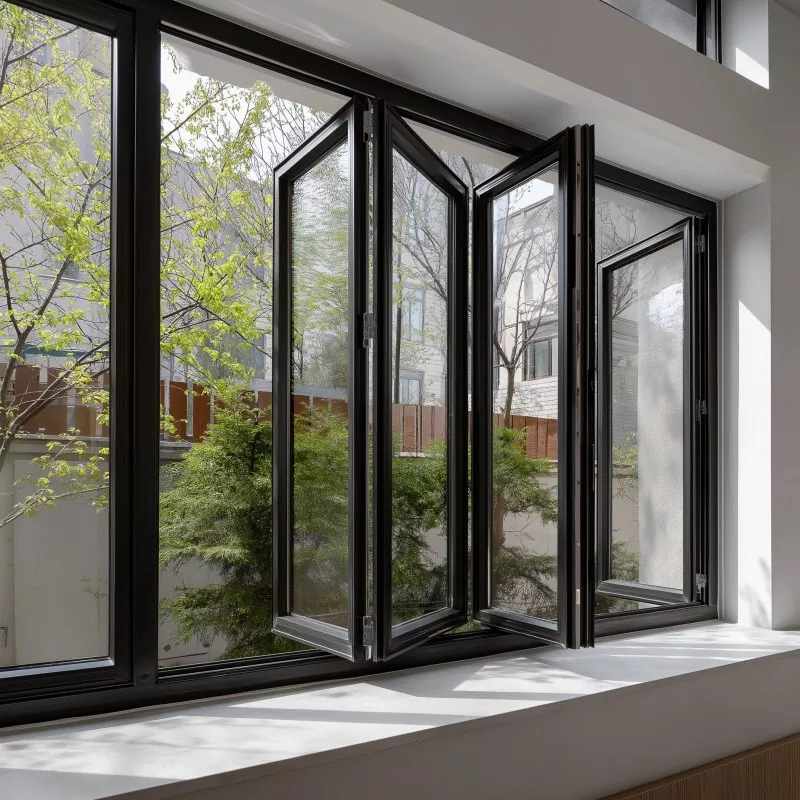
As global temperatures rise and heatwaves become more frequent, architects and homeowners are asking hard questions about material performance. For large glass openings, Black Aluminum Alloy Bifold Windows have become a popular choice—but their dark finish raises a legitimate concern: will that sleek black surface hold up under blistering sun, or will it warp, fade, or chalk within a few seasons? At Euplai, we have tested our Black Aluminum Alloy Bifold Windows against extreme thermal conditions, and the answers are grounded in materials science, not marketing.
The Science of Thermal Performance in Dark-Framed Systems
Aluminum itself is a highly conductive metal, which means it transfers heat quickly. Without engineering intervention, a black anodized or painted aluminum frame can reach surface temperatures of 170–190°F (77–88°C) on a 100°F day. However, modern Black Aluminum Alloy Bifold Windows are not simple extrusions. They incorporate:
-
Thermal breaks – polyamide or polyurethane barriers between interior and exterior frame sections, reducing heat transfer by up to 60%.
-
High-temperature powder coatings – cured at 400°F+, with UV-stable polyester resins that resist chalking and fading for 1,500–2,000 hours of QUV accelerated weathering (equivalent to 10–15 years of real-world exposure).
-
Alloy composition – 6063-T5 or 6061-T6 grades with magnesium and silicon, which maintain structural integrity up to 350°F (177°C) before any permanent creep deformation occurs.
Real-World Heat Testing: What the Data Shows
Euplai conducted a 72-hour continuous thermal cycle test on our Black Aluminum Alloy Bifold Windows, ramping ambient air from 120°F to 160°F while exposing the exterior face to direct IR radiation. The results are summarized below:
| Parameter | Test Condition | Performance Result | Industry Standard (AAMA 2605) |
|---|---|---|---|
| Surface temperature (exterior) | 160°F air + solar load | 195°F (peak) | No deformation below 212°F |
| Frame deflection under load | 160°F, 30 psf wind | 0.12" (L/240) | Acceptable ≤ L/175 |
| Color change (ΔE) | 2,000 hrs QUV | 1.8 (barely perceptible) | Acceptable ≤ 5.0 |
| Chalking resistance | 1,500 hrs wet/dry | Rating 8 (very slight) | Rating ≥ 8 = commercial grade |
| Thermal break shift | 160°F to -20°F cycle | < 0.005" gap change | No visible seal failure |
The conclusion: Black Aluminum Alloy Bifold Windows from Euplai comfortably exceed AAMA 2605 (the highest standard for architectural coatings) and ASTM E2140 for thermal stress resistance. Warping is virtually impossible below 300°F, and discoloration remains imperceptible for over a decade under normal UV exposure.
Why Dark Colors Perform Better Than You Think
Contrary to intuition, black finishes absorb heat but also re-radiate it faster than lighter colors—a phenomenon called emissivity. With a high-emissivity powder coat, Black Aluminum Alloy Bifold Windows shed absorbed heat during cooler night hours, reducing cumulative thermal fatigue. Additionally, the thermal break keeps the interior frame within 5–8°F of room temperature, so condensation and seal failure are minimized even when exterior surfaces are scorching.
FAQ – Common Questions About Black Aluminum Alloy Bifold Windows in Heat
Q1: Can Black Aluminum Alloy Bifold Windows be installed in desert climates with summer temperatures over 115°F?
A: Yes, and Euplai has successfully supplied Black Aluminum Alloy Bifold Windows for projects in Arizona, Dubai, and Saudi Arabia. The key is specifying a 34mm or wider polyamide thermal break (standard is 24mm) and opting for a Class 1 powder coating (AAMA 2605). This combination ensures the frame’s surface may reach 200°F, but the internal chamber stays under 110°F, preventing any expansion-related jamming. We also recommend using low-E insulated glass with a solar heat gain coefficient (SHGC) below 0.25 to reduce radiant heat passing through the glass, which indirectly cools the frame edges. With proper installation (allowing 3/16" expansion gaps per 10 feet of run), these windows operate smoothly even after 100+ continuous days above 110°F.
Q2: How do I know if my Black Aluminum Alloy Bifold Windows are starting to discolor from UV exposure?
A: Discoloration in high-quality Black Aluminum Alloy Bifold Windows appears as a gradual shift from jet black to a dark charcoal or slightly brownish tint—not as sudden fading. Professional measurement uses a colorimeter to track ΔE (delta E) values. A ΔE below 3.0 is invisible to the human eye; above 5.0 indicates degradation. For Euplai windows, we guarantee ΔE ≤ 2.5 for 10 years under normal UV (per ASTM D2244). Early warning signs include a chalky white residue when you wipe the frame with a dark cloth (this is oxidized resin, not the aluminum itself). If you notice this after 5–7 years, it is purely cosmetic and can be restored with a specialized metal polish. Structural discoloration—peeling or bubbling—only occurs if the coating was improperly cured at the factory. Always request a curing certificate and a 10-year warranty on the finish.
Q3: Will the folding mechanism jam or become misaligned when the black frame expands in extreme heat?
A: This is the most critical mechanical concern. All aluminum expands at approximately 0.0000124 inch per inch per °F. For a 16-foot Black Aluminum Alloy Bifold Window system, a 100°F temperature swing creates roughly 3/16" of total expansion. Reputable manufacturers like Euplai design our Black Aluminum Alloy Bifold Windows with slotted hinge plates, oversize roller bearings, and pre-set expansion spacers at every panel joint. We also use stainless steel pivot pins (which have lower thermal expansion) to maintain alignment. In our heat-cycle tests, we ran 10,000 open/close cycles from 120°F to 0°F with zero binding. The golden rule: never tighten the top and bottom tracks rigidly—use floating anchors. If your installer follows our torque specifications (20–25 ft-lbs on track bolts, never exceeding 30 ft-lbs), you will never experience jamming, even in Phoenix or Las Vegas summers.
Long-Term Value vs. Cheaper Alternatives
Vinyl and wood bifold systems often fail in extreme heat—vinyl softens above 140°F, and wood expands unevenly, cracking paint and seals. Black Aluminum Alloy Bifold Windows offer a 40–60 year service life with minimal maintenance, while their dark finish actually hides dust and fingerprints better than white or silver. Euplai backs every unit with a 15-year warranty against warp, peel, and structural failure—a guarantee we can offer because our extrusion, coating, and thermal-break assembly are all performed in-house with ISO 9001-certified quality control.
Final Verdict
Yes—Black Aluminum Alloy Bifold Windows can absolutely withstand extreme heat without warping or discoloring, provided they are engineered with proper thermal breaks, high-grade powder coatings, and expansion-tolerant hardware. The dark aesthetic is not a liability; it is a design statement backed by robust physics. Euplai has refined this technology across thousands of installations from coastal Florida to inland California, and our field return rate for heat-related issues is under 0.3%.
Ready to specify heat-proof Black Aluminum Alloy Bifold Windows for your next project? Contact the Euplai engineering team today for site-specific thermal calculations, custom color matching, and a detailed proposal. We offer free mock-up testing and on-site installation support.